
Share this
Abstract: This study aims to investigate the effect of Olimpum BMT21 biostimulants, prepared in different formulations, on dry matter production in maize. In the experiment conducted under greenhouse conditions, four different BMT21 biostimulant mixtures were applied foliarly at three different doses (0, 50 ppm, and 100 ppm). The results showed that BMT21 biostimulant increased dry matter production in maize. Specifically, BMT21-A and BMT21-B mixtures resulted in the highest increase in dry matter production.
Keywords: Biostimulant, BMT21, Maize, Dry Matter, Yield Increase
1. Introduction
Biostimulants are organic-based substances that promote plant growth and development, enhance yield, and improve tolerance to abiotic stress conditions (du Jardin, 2015). Various components, such as humic and fulvic acids, amino acids, seaweed and yeast extracts, chitin-like polymers, and beneficial microorganisms, are used as biostimulants (Calvo et al., 2014). Biostimulants exert their effects by improving nutrient uptake, enhancing photosynthesis capacity, and activating stress tolerance mechanisms in plants (Yakhin et al., 2017).
2. Material and Methods
The experiment was conducted under greenhouse conditions, with maize used as the test plant. The plants were established in 2 kg pots, and all pots received a base fertilization of 100 ppm N, 60 ppm P, and 80 ppm K. After three weeks, four different Olimpum BMT21 biostimulant formulations (BMT21-A, BMT21-B, BMT21-C, and BMT21-D) were applied foliarly at three different doses (0, 50 ppm, and 500 ppm). The applications were repeated three times at one-week intervals. The plants were harvested at the soil surface after eight weeks and prepared for analysis according to standard procedures. The dry matter content of the maize plants was determined by drying the plant samples to a constant weight at 70°C.
3. Results
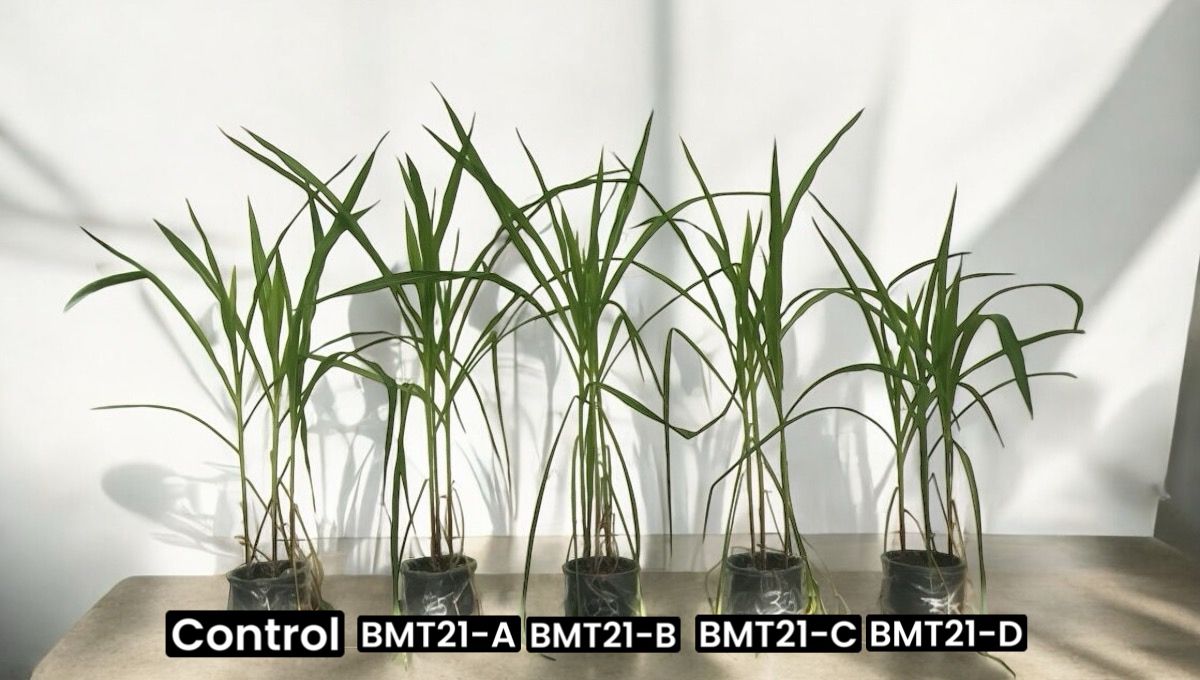
All different formulations of BMT21 biostimulant increased the dry matter content of maize compared to the control group. The highest increase was observed with BMT21-A, showing an 8.28% rise. BMT21-B also resulted in a 7.14% increase in dry matter content (Figure 1).

Figure 1. Effect of the biostimulants used in the experiment on plant dry matter content
4. Discussion and Conclusion
All applications increased the dry matter content of maize compared to the control. BMT21-A and BMT21-B applications provided higher dry matter increases than the other treatments. This effect is thought to result from the carriers used in the biostimulants, which may have enhanced photosynthesis capacity or provided nutrients to the plants. The results suggest that BMT21 biostimulant has potential as a biostimulant to increase yield and improve quality in plant production compared to other treatments. Further studies are needed to determine the effects of these biostimulants on product quality and yield in field trials.
References
• Calvo, P., Nelson, L., & Kloepper, J. W. (2014). Agricultural uses of plant biostimulants. Plant and Soil, 383(1), 3-41.
• du Jardin, P. (2015). Plant biostimulants: definition, concept, main categories and regulation. Scientia Horticulturae, 196, 3-14.
• Yakhin, O. I., Lubyanov, A. A., Yakhin, I. A., & Brown, P. H. (2017). Biostimulants in plant science: a global perspective. Frontiers in Plant Science, 7, 2049.
To learn more about BMT 21 technology and discover its advantages, visit our innovation&technology page.